AlgoWay Blog
Guides, manuals and platform references.
Core
- All articles
- FAQ
- PineConnector alternative
- TradersPost alternative
- Automate TradingView alerts
- Automate Telegram signals
- AlgoWay CopyTrader
- cTrader Copier
- TrendSpider with AlgoWay
- How to Automate a TradingView Indicator with Dynamic SL/TP and 1% Risk on MT5
JSON & Alerts
- JSON schema
- Manual alerts
- TradingView without paid subscription
- AlgoWay Strategy Integration in Pine Script
- Python Trading Bot Webhook Integration
- TRALADAL - TradingView Alert Adapter
- TradingView Order Action Alert
- How to use Clone Mode
MT5 / Expert Advisors
Errors
Integrations
- MetaTrader 5
- Tradovate
- TradeLocker
- Match-Trader
- DXtrade
- Capital.Com
- Binance
- Bybit
- MEXC
- OKX
- Bitget
- Hyperliquid
- BingX
- Alpaca
- Interactive Brokers
- Gate.io
- Coinbase
- TooBit
- WEEX
- ProjectX
- Rithmic
- cTrader logic
Other Publications
- MT5 EA Webhook JSON Reference
- OANDA MT5 with AlgoWay
- Buy Webhook via Buy Me a Coffee
- AlgoWay vs PineConnector
- Compare AlgoWay with other trading automation tools
- AlgoWay Red News Filter
- Why Paid Trading Indicators Avoid Verifiable Backtests
- How Trade Automation Tools Mislead You
- utomating a Prop-Firm Eval End to End:
- ATP Premium Indicator Testing Bot
- Why TradingView Backtests Win but Live Trades Lose
- Best Prop Firms for Trading Automation and Telegram Signal Copy in 2026
- Four AIs, One Trader, and the Strange Case of TradingView to Alpaca
- TradingView Automation
AlgoWay Strategy Lab
MT5 Real Ticks vs Generated Ticks: Why Tests Disagree
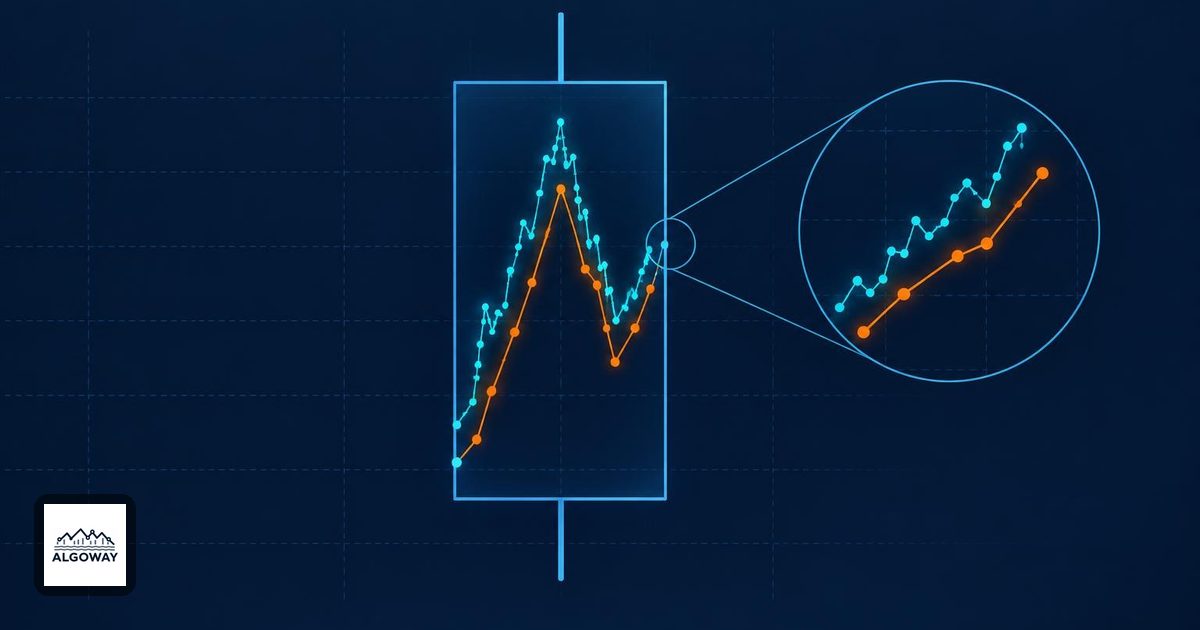
Two MT5 tests can use the same Expert Advisor, dates and visible candles yet produce different trades. The missing comparison is often the price sequence inside each minute. “Every tick” generates that sequence; “Every tick based on real ticks” uses broker-recorded ticks where available.
For automated trading, this is more than a chart-detail setting. A robot that reacts between candle closes may encounter a different entry, stop or trailing-stop event when the tick path changes. Before trusting an MT5 automation backtest, identify which data drove its decisions and which parts of the eventual execution workflow the test actually represents.
The two modes do not use the same evidence
MetaQuotes explains the distinction in its real and generated ticks reference. Generated ticks are constructed from one-minute records. Real-tick tests use ticks accumulated by the broker. Real-tick spreads can vary inside a minute; generated ticks use the spread recorded for the corresponding minute bar.
There is also a fallback: if a minute bar exists but its ticks are missing, MT5 generates ticks for that minute. Selecting the real-tick mode therefore does not prove that every minute contains recorded ticks. Data availability belongs in the explanation of the test, alongside the selected mode.
A candle's open, high, low and close are a summary. They do not describe every visit to a level or the timing of each quote. Two paths can share that summary and give a rule different opportunities to act. Calling both tests “the same historical period” hides precisely the difference an intrabar strategy cares about.
One candle can contain two different trade stories
Imagine a deliberately simplified Bid-price candle: open 100, high 104, low 98 and close 102. A long position is already open, with a stop at 99 and a target at 103. For this illustration, assume exits occur when the Bid touches their levels, and set aside gaps, costs and execution delay.
- On a path that visits 104 before 98, price touches the target before the stop.
- On a path that visits 98 before 104, price touches the stop before the target.
The candle summary is identical. The first exit is not. These invented paths illustrate the information lost in OHLC data; they are not a claim about which path MT5 generates for this candle and are not results from an EA test.
A trailing rule adds another dependency. If it moves a stop after a favorable excursion, the position's protection at a later price depends on what happened earlier. Even a strategy that opens only once per bar can still have intrabar exits. “My entries use closed candles” is not enough to show that tick mode is irrelevant.
Keep the experiment smaller than the disagreement
Use the MT5 Strategy Testing settings to run a controlled comparison. MetaQuotes documents both tick-model selection and execution-delay simulation. Delay is a separate assumption: a change in it should not be mistaken for a tick-data effect.
- Freeze the setup. Record the EA build, inputs, broker server, exact symbol, period, dates, deposit, leverage, cost settings and execution-delay setting. Save the report and configuration for each run.
- Change only tick mode. First compare generated ticks with real ticks over the same interval. Avoid optimizing parameters at the same time.
- Find the first divergent decision. Compare the earliest differing entry, modification or exit, not just the final balance. Later trades may differ because the earlier event changed the position or available capital.
- Inspect that small interval. Check the relevant Bid/Ask quotes, signal condition, protective levels and tester journal. Establish whether the difference began in signal generation, spread, stop activation or another event.
- Classify the result. Record “sensitive to tick path,” “different spread exposure,” or the supported alternative. Do not conclude “platform bug” or “robust strategy” from a balance difference alone.
If the trade counts differ, distinguish orders from executions and resulting positions before comparing them. The MT5 orders, deals and positions guide explains why those counts are not interchangeable.
Real ticks improve the input, not the certainty
Recorded quotes answer a historical-data question. They do not establish what a future order will receive, nor do they prove that a separate alert-delivery and broker-execution chain was tested. If your eventual workflow starts with a TradingView alert, state explicitly whether your experiment reproduced that signal source or tested only an MT5 EA's local rules.
This is a useful boundary when comparing an MT5 test with a TradingView backtest: different signal implementations, price feeds and execution assumptions can coexist. Our backtest versus live execution guide covers that broader audit. Changing MT5 tick mode addresses one part of it.
Keep generated-tick runs clearly labeled when using them for preliminary comparisons. For a strategy whose behavior depends on intraminute prices, examine available real-tick data before drawing conclusions from the generated path. Then observe the unchanged rules in a forward test and compare actual decisions with the specification. A better historical input is useful evidence; it is not a receipt for future profits.