AlgoWay Blog
Guides, manuals and platform references.
Core
- All articles
- FAQ
- PineConnector alternative
- TradersPost alternative
- Automate TradingView alerts
- Automate Telegram signals
- AlgoWay CopyTrader
- cTrader Copier
- TrendSpider with AlgoWay
- How to Automate a TradingView Indicator with Dynamic SL/TP and 1% Risk on MT5
JSON & Alerts
- JSON schema
- Manual alerts
- TradingView without paid subscription
- AlgoWay Strategy Integration in Pine Script
- Python Trading Bot Webhook Integration
- TRALADAL - TradingView Alert Adapter
- TradingView Order Action Alert
MT5 / Expert Advisors
Errors
Integrations
- MetaTrader 5
- TradeLocker
- Match-Trader
- DXtrade
- Capital.Com
- Binance
- Bybit
- MEXC
- OKX
- Bitget
- Hyperliquid
- BingX
- Alpaca
- Interactive Brokers
- Gate.io
- Coinbase
- WEEX
- ProjectX
- cTrader logic
Other Publications
- MT5 EA Webhook JSON Reference
- OANDA MT5 with AlgoWay
- Buy Webhook via Buy Me a Coffee
- AlgoWay vs PineConnector
- Compare AlgoWay with other trading automation tools
- AlgoWay Red News Filter
- Why Paid Trading Indicators Avoid Verifiable Backtests
- How Trade Automation Tools Mislead You
- utomating a Prop-Firm Eval End to End:
- ATP Premium Indicator Testing Bot
- Why TradingView Backtests Win but Live Trades Lose
- Best Prop Firms for Trading Automation and Telegram Signal Copy in 2026
- Four AIs, One Trader, and the Strange Case of TradingView to Alpaca
AlgoWay Strategy Lab
TradingView Alerts to Alpaca Webhook Automation with AlgoWay
AlgoWay connects TradingView alerts to Alpaca through webhook automation. Instead of writing and hosting your own TradingView Alpaca bot, you create an Alpaca webhook in AlgoWay, paste your Alpaca API credentials, test the connection, and send structured TradingView alert JSON to the AlgoWay webhook URL.
This guide explains how to set up a TradingView to Alpaca webhook for automated stock trading, ATM call and put option trading, paper trading tests, and strategy alert execution. The workflow is simple:
TradingView alert -> AlgoWay webhook -> Alpaca Trading API -> Alpaca accountAlpaca already supports API-based trading, and TradingView can send alert data to external systems through webhooks. AlgoWay sits between them and handles the routing layer: it receives the alert, validates the JSON, maps the order fields, and sends the trade command to Alpaca.
This guide covers the complete TradingView-to-Alpaca workflow, including API credential setup, paper trading, AlgoWay webhook creation, JSON alert configuration, testing and troubleshooting.
What This Alpaca Webhook Setup Does
An Alpaca webhook in AlgoWay lets you receive trading signals from TradingView and route them to Alpaca using your own Alpaca API key and secret.
With this setup, AlgoWay can help you:
- connect TradingView strategy alerts to Alpaca;
- send buy, sell, and close-style commands through a structured JSON message;
- test automation on an Alpaca paper account before live trading;
- avoid building a custom server just to receive TradingView webhooks;
- use AlgoWay logs to inspect received alerts and execution responses;
- keep TradingView as the signal source and Alpaca as the execution destination.
The purpose is not to replace your trading strategy. AlgoWay does not create profitable signals by itself. It provides the webhook automation layer between the signal and the broker API.
TradingView to Alpaca: How the Workflow Works
The full automation chain has four parts:
- TradingView generates the alert from a strategy, indicator, or manual alert.
- TradingView webhook sends the alert message to your AlgoWay webhook URL.
- AlgoWay reads the JSON, validates the required fields, and routes the command.
- Alpaca receives the order request through the Alpaca Trading API.
This is different from manually trading an Alpaca account from a chart. Here the goal is automated Alpaca trading from TradingView alerts. Your TradingView script or alert logic decides when to send the signal, while AlgoWay handles the webhook-to-Alpaca execution route.
TradingView to Alpaca Options Trading with optionType
AlgoWay can also use a TradingView alert on an underlying stock or ETF to automate long call and put option entries in Alpaca without requiring the TradingView alert to contain an OCC option symbol, strike price, or expiration date. This is what the optional optionType parameter is used for. When optionType is set to call or put, the value in ticker is treated as the underlying symbol, for example SPY, QQQ, AAPL or another Alpaca-supported underlying. For an entry with order_action: "buy", AlgoWay reads the current underlying price, checks the available active and tradable Alpaca option contracts, selects the nearest available expiration and then chooses the strike closest to the current underlying price, producing an at-the-money contract automatically. The resulting order is sent to Alpaca as a long option entry. This makes the parameter useful for TradingView breakout alerts, support/resistance alerts, indicator signals, Pine Script signals and other workflows where the TradingView side knows whether the signal is bullish or bearish but does not know the exact option contract that should be traded. A bullish signal can therefore buy an ATM call and a bearish signal can buy an ATM put with the same basic webhook structure. To close the option, use order_action: "flat" together with the same underlying ticker and the same optionType. AlgoWay does not calculate a new ATM contract for the close. Instead, it looks for the existing long option position of that type on the underlying and sends a sell-to-close order for the actual contract already held in Alpaca. This distinction is important because the underlying price may have moved after entry, so the current ATM strike may no longer be the strike that was originally purchased. For this options workflow, buy is used to open the long call or put and flat is used to close it; sell is not used as the close command. The option quantity in order_contracts is interpreted as whole option contracts. Alpaca options should be tested in paper trading first, and the Alpaca account must have the required options trading permissions. AlgoWay currently does not attach stock-style bracket SL/TP fields to these option entries, so option alerts using optionType should not include stop_loss, take_profit, sl_price or tp_price.
Buy an ATM Call
Use optionType: "call" with order_action: "buy" when a bullish TradingView signal should buy an automatically selected ATM call on the underlying symbol.
{
  "platform_name": "alpaca",
  "ticker": "SPY",
  "order_contracts": 1,
  "order_action": "buy",
  "optionType": "call"
}
Close the Existing Call Position
Use flat with the same underlying and optionType: "call". AlgoWay finds the existing long SPY call position and sends a sell-to-close order for that actual option contract.
{
  "platform_name": "alpaca",
  "ticker": "SPY",
  "order_contracts": 1,
  "order_action": "flat",
  "optionType": "call"
}
Buy an ATM Put
Use optionType: "put" with order_action: "buy" when a bearish TradingView signal should buy an automatically selected ATM put on the underlying symbol.
{
  "platform_name": "alpaca",
  "ticker": "SPY",
  "order_contracts": 1,
  "order_action": "buy",
  "optionType": "put"
}
Close the Existing Put Position
Use flat with the same underlying and optionType: "put" to close the existing long put position. AlgoWay uses the contract already held in Alpaca rather than resolving a new ATM strike.
{
  "platform_name": "alpaca",
  "ticker": "SPY",
  "order_contracts": 1,
  "order_action": "flat",
  "optionType": "put"
}buy + optionType: call, bearish option entry = buy + optionType: put, and closing either long option = flat with the same optionType.
Before You Start
Before creating an AlgoWay Alpaca webhook, prepare the following:
- an AlgoWay account;
- an Alpaca account with access to API keys;
- Alpaca paper API credentials for testing, or live credentials for production trading;
- a TradingView alert source, such as a strategy alert or indicator alert;
- a valid JSON alert message with order action, symbol, and quantity.
For safety, start with Alpaca paper trading first. Paper trading lets you test the automation route without placing live orders.
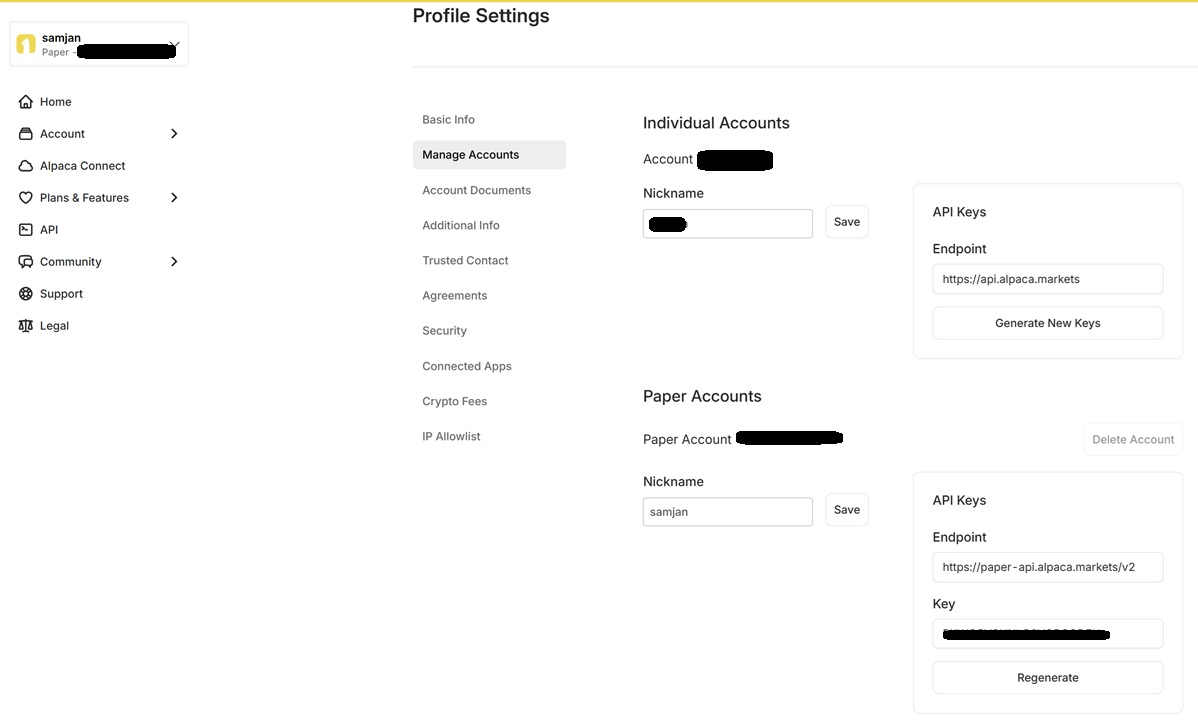
Step 1. Get Your Alpaca API Keys
Log in to your Alpaca account and open the API section. Alpaca provides API credentials that AlgoWay needs in order to send orders to your selected Alpaca environment.
For testing, use your Alpaca paper trading credentials. For live trading, use live credentials only after you have tested the workflow, order size, symbols, and alert messages.
- Log in to Alpaca.
- Open the API or API keys section.
- Select the correct environment: paper or live.
- Generate or copy your API key.
- Copy your API secret before leaving the page.
Step 2. Save the Alpaca API Key and Secret
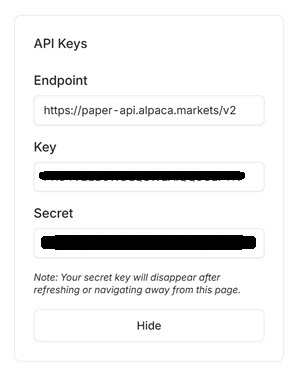
After generating new keys, Alpaca shows the API key and API secret. Copy both values carefully.
The secret may not be visible again after you leave the page. If the secret is lost, generate a new key pair and update your AlgoWay webhook settings.
Step 3. Create an Alpaca Webhook in AlgoWay
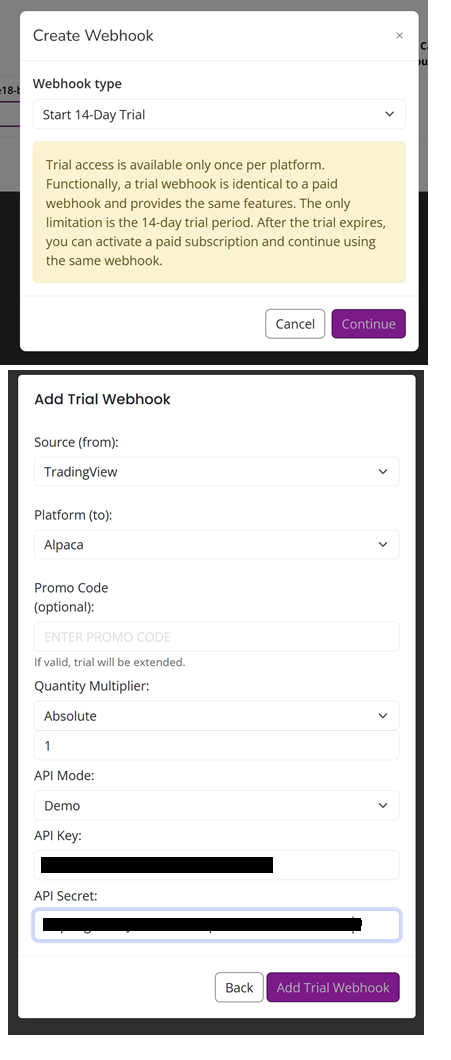
Now create the Alpaca webhook in AlgoWay. This webhook is the endpoint that receives TradingView alerts and routes them to Alpaca.
- Log in to your AlgoWay dashboard.
- Click Add Trial Webhook or Add Main Webhook.
- Select the webhook type you want to create.
- Choose TradingView as the source.
- Choose Alpaca as the destination platform.
Fill in the Alpaca connection fields:
- Source (from): TradingView
- Platform (to): Alpaca
- Quantity Multiplier: Absolute, unless your setup requires another mode
- API Mode: Demo for Alpaca paper trading, or Live for live trading
- API Key: paste your Alpaca API key
- API Secret: paste your Alpaca API secret
After saving, AlgoWay creates an Alpaca webhook URL. This is the URL you will later paste into TradingView.
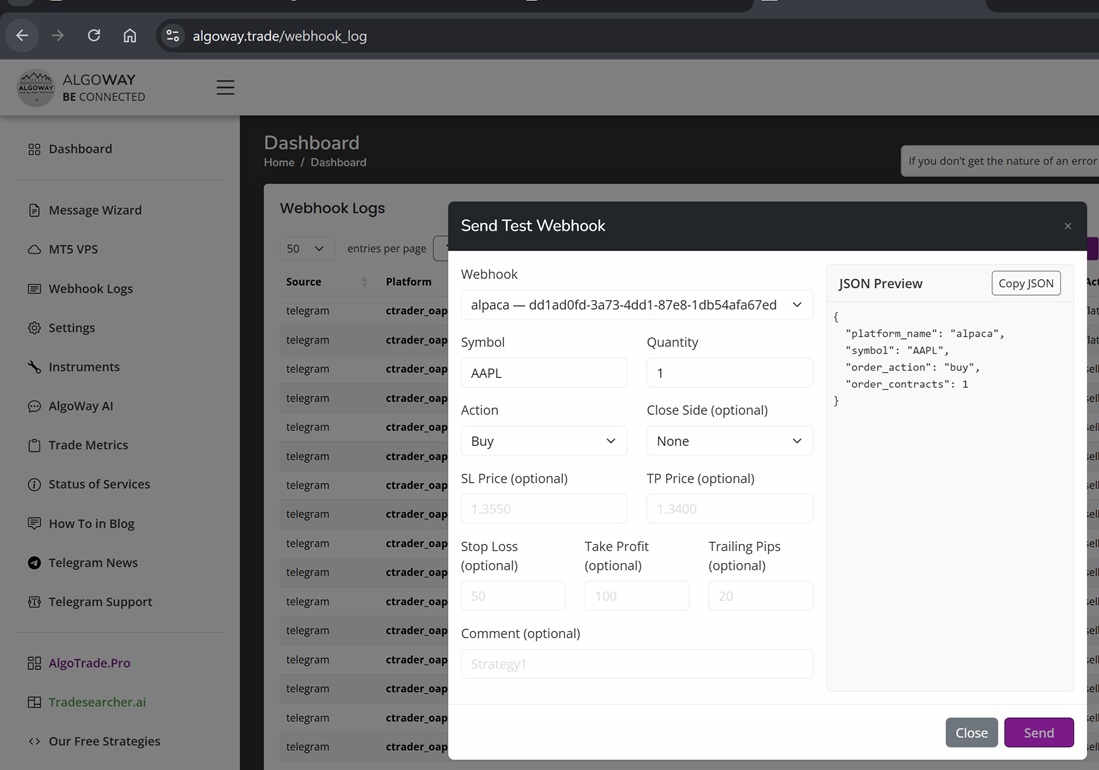
Step 4. Test the Alpaca Webhook Before Using TradingView
Before connecting a real TradingView alert, test the webhook from the AlgoWay dashboard. This confirms that your Alpaca API credentials, environment mode, and symbol format are correct.
- Open Webhook Logs in AlgoWay.
- Click Test Webhook.
- Select your Alpaca webhook.
- Use a stock ticker such as
AAPLorTSLA. - Set the order action and quantity.
- Send the test and check the response in logs.
Example AlgoWay test JSON for Alpaca:
{
  "platform_name": "alpaca",
  "ticker": "AAPL",
  "order_action": "buy",
  "order_contracts": 1
}
If the test fails, check the API mode, API key, API secret, ticker, and order quantity before moving to TradingView.
Step 5. Create a TradingView Strategy Alert for Alpaca
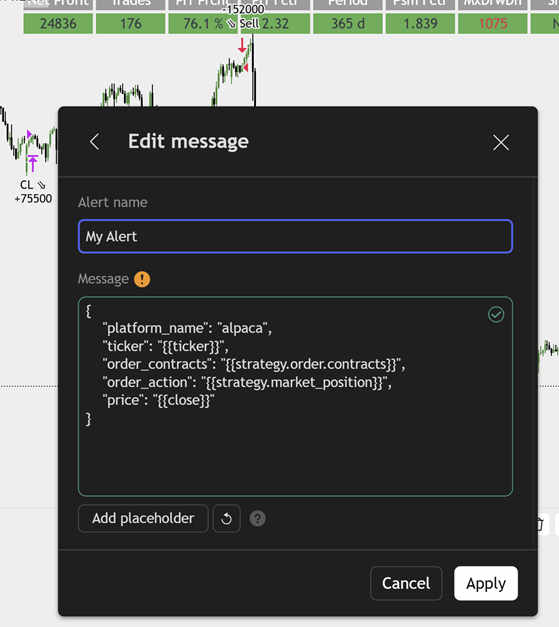
If you use a TradingView strategy, the alert message can use TradingView placeholders. TradingView replaces these placeholders with real strategy values when the alert fires.
Paste this JSON into the TradingView alert message box:
{
  "platform_name": "alpaca",
  "ticker": "{{ticker}}",
  "order_contracts": "{{strategy.order.contracts}}",
  "order_action": "{{strategy.market_position}}",
  "price": "{{close}}"
}
This message tells AlgoWay which platform to use, which symbol to trade, how many units to send, and what action the strategy is currently producing.
Common TradingView placeholders in this setup:
{{ticker}}— the chart ticker;{{strategy.order.contracts}}— the strategy order size;{{strategy.market_position}}— the strategy position state;{{close}}— the close price at alert time.
Step 6. Add the AlgoWay Webhook URL in TradingView
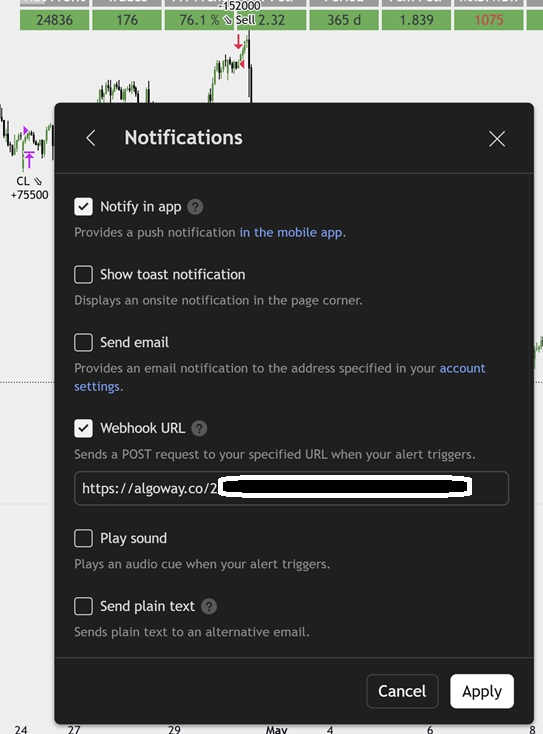
In the TradingView alert window, open the notifications section, enable Webhook URL, and paste your AlgoWay Alpaca webhook URL.
Your webhook URL will use the unique UUID from your AlgoWay webhook:
https://algoway.co/your-webhook-uuidAfter adding the URL and JSON message, save the alert. When TradingView triggers the alert, the message is sent to AlgoWay and then routed to Alpaca.
Indicator Alerts and Manual TradingView Alerts
Strategy alerts are not the only option. AlgoWay can also work with indicator alerts and manually prepared alert messages, as long as the final message is valid JSON.
If your indicator does not generate a ready-to-use JSON message, use the tools inside AlgoWay:
- Message Wizard — builds a valid AlgoWay webhook message manually;
- AlgoWay AI — helps convert a plain text trading idea into structured AlgoWay JSON.
This is useful when your indicator sends simple text such as “buy AAPL” but the Alpaca webhook needs structured fields.
Required JSON Fields for AlgoWay Alpaca Automation
For most Alpaca webhook messages, the core fields are:
| Field | Example | Purpose |
|---|---|---|
platform_name |
alpaca |
Tells AlgoWay to route the command to Alpaca. |
ticker |
AAPL |
Defines the stock or supported Alpaca symbol. |
order_action |
buy |
Defines the trade action. |
order_contracts |
1 |
Defines the order quantity. |
optionType |
call, put |
Optional Alpaca options field. When present, ticker is treated as the underlying symbol. With buy, AlgoWay selects an ATM call or put automatically; with flat, AlgoWay closes the existing long option position of the same type. |
Optional fields may depend on your strategy and AlgoWay configuration. For Alpaca options, use optionType with the value call or put. Always test new fields in paper mode before using them in live trading.
Common Alpaca Webhook Problems
Wrong API Mode
Do not mix paper credentials with live mode, or live credentials with demo mode. Use paper credentials for testing and live credentials only when you intentionally want live trading.
Invalid JSON in TradingView
TradingView webhook automation depends on a clean alert message. Use double quotes for JSON strings and avoid broken commas, comments, or unclosed brackets.
Wrong Ticker Format
Check that the symbol sent by TradingView is accepted by the selected Alpaca environment. If needed, send a fixed ticker value first, then switch back to {{ticker}} after testing.
Zero or Empty Quantity
If {{strategy.order.contracts}} is empty or zero, AlgoWay may not be able to send a valid order. Check your TradingView strategy settings and order size.
Wrong optionType or Wrong Close Action
For Alpaca options, optionType must be exactly call or put. Use buy to open the long option and flat to close it. Do not use sell as the close command for this workflow.
No Webhook URL in TradingView
The alert must have the AlgoWay webhook URL enabled. If the webhook URL field is empty, TradingView will not send the alert to AlgoWay.
Why Use AlgoWay Instead of Writing Your Own TradingView Alpaca Bot?
You can build your own TradingView to Alpaca bot with a server, webhook endpoint, JSON parser, logging system, API client, error handling, and security checks. That approach gives full control, but it also creates maintenance work.
AlgoWay is designed for traders who want the execution bridge without maintaining infrastructure. The dashboard creates the webhook, stores the integration settings, receives the TradingView alert, and routes the command to Alpaca.
This makes AlgoWay useful for traders who want:
- a no-code TradingView to Alpaca webhook bridge;
- paper trading tests before live execution;
- clear logs for received alerts and responses;
- a single dashboard for multiple platforms;
- less custom server maintenance.
Related AlgoWay Guides
After setting up Alpaca, these guides may help you build a more reliable automation workflow:
- How to create a webhook in TradingView
- TradingView webhook alerts and automation basics
- AlgoWay JSON schema for automated trading webhooks
- How to fix TradingView webhook Error 415
- Risk management and automated trade execution
Key Takeaway
To automate Alpaca trading from TradingView, you need three things: Alpaca API credentials, an AlgoWay Alpaca webhook, and a valid TradingView alert message. Once these parts are configured, AlgoWay can receive TradingView webhook alerts and route stock orders or ATM call/put option commands to Alpaca.
AlgoWay turns TradingView alerts into Alpaca automation without forcing you to run your own webhook server.