AlgoWay Blog
Guides, manuals and platform references.
Core
- All articles
- FAQ
- PineConnector alternative
- TradersPost alternative
- Automate TradingView alerts
- Automate Telegram signals
- AlgoWay CopyTrader
- cTrader Copier
- TrendSpider with AlgoWay
- How to Automate a TradingView Indicator with Dynamic SL/TP and 1% Risk on MT5
JSON & Alerts
- JSON schema
- Manual alerts
- TradingView without paid subscription
- AlgoWay Strategy Integration in Pine Script
- Python Trading Bot Webhook Integration
- TRALADAL - TradingView Alert Adapter
- TradingView Order Action Alert
- How to use Clone Mode
MT5 / Expert Advisors
Errors
Integrations
- MetaTrader 5
- Tradovate
- TradeLocker
- cTrader
- Match-Trader
- DXtrade
- Capital.Com
- Binance
- Bybit
- MEXC
- OKX
- Bitget
- Hyperliquid
- BingX
- Alpaca
- Interactive Brokers
- Gate.io
- Coinbase
- TooBit
- WEEX
- KuCoin
- Kraken
- ProjectX
- Rithmic
Other Publications
- MT5 EA Webhook JSON Reference
- OANDA MT5 with AlgoWay
- Buy Webhook via Buy Me a Coffee
- AlgoWay vs PineConnector
- Compare AlgoWay with other trading automation tools
- AlgoWay Red News Filter
- Why Paid Trading Indicators Avoid Verifiable Backtests
- How Trade Automation Tools Mislead You
- utomating a Prop-Firm Eval End to End:
- ATP Premium Indicator Testing Bot
- Why TradingView Backtests Win but Live Trades Lose
- Best Prop Firms for Trading Automation and Telegram Signal Copy in 2026
- Four AIs, One Trader, and the Strange Case of TradingView to Alpaca
- TradingView Automation
AlgoWay Strategy Lab
Elixo AI: One Platform for Smarter Crypto Trading Automation
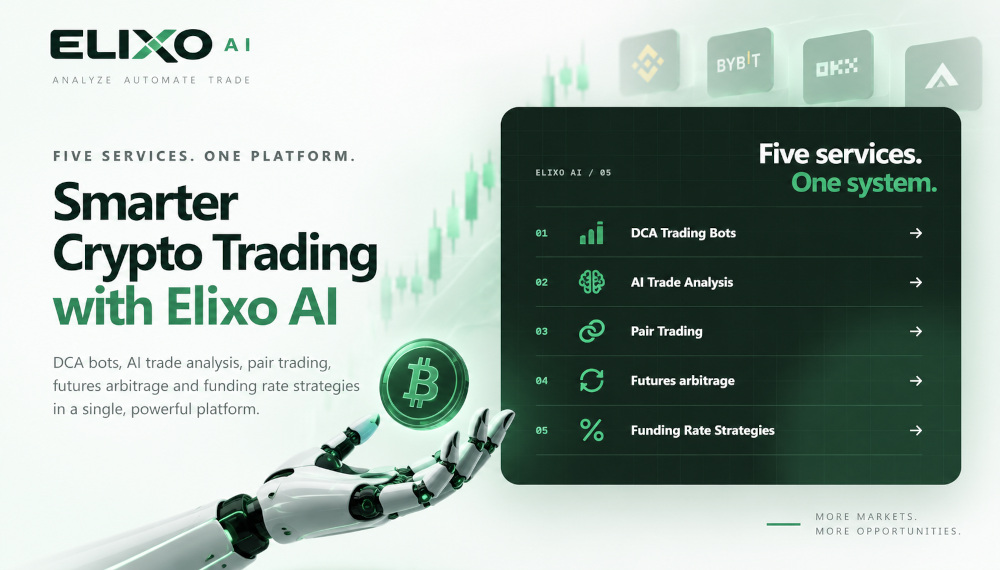
Crypto trading software has a habit of multiplying. One service watches funding rates, another runs DCA bots, another scans arbitrage opportunities, and before long a trader has enough browser tabs open to qualify as a small operations department. Elixo AI takes a different route: five distinct trading services live inside one platform and one subscription.
Last updated: 2026-09-06 • Author: AlgoWay
Elixo AI, also presented as Elixo Bots, is an AlgoWay partner focused on crypto trading analytics and automation. Its current platform combines DCA trading bots, AI trade analysis, pair trading, futures arbitrage and funding-rate strategies in one dashboard. The important part is not simply that five tools exist. It is that they are designed to solve five different trading problems without forcing the user to rebuild the surrounding infrastructure every time the market calls for a different approach.
Quick Answer: What Is Elixo AI?
Elixo AI is a crypto trading automation platform built around five core services. Some are directional, some are market-neutral, and some focus on structural differences between exchanges rather than predicting where price will go next.
| Elixo AI service | What it is designed to do |
|---|---|
| DCA Trading Bots | Automate entries, averaging steps, take-profit targets and protective exit rules according to predefined strategy settings. |
| AI Trade Analysis | Evaluate a potential entry using market data, news, sentiment, indicators and futures context before returning LONG, SHORT or WAIT. |
| Pair Trading | Build long/short positions around the relative movement of two instruments rather than relying entirely on overall market direction. |
| Futures Arbitrage | Search for price differences between exchanges and manage opposing positions where a spread may converge. |
| Funding Rate Strategies | Monitor funding rates and compare hedged opportunities across exchanges using normalized rate and APR data. |
This mix is more useful than a platform built around one supposedly universal strategy. A DCA bot, an arbitrage scanner and a pair-trading workflow are not three versions of the same idea. They answer different questions. Elixo AI puts them in the same environment so a trader can choose the method that fits the task instead of trying to force every market into one template.
AI Trade Analysis That Can Also Decide to Wait
Elixo AI's analysis service is built around a practical decision rather than an endless collection of charts. The trader specifies the instrument, expected direction, Take Profit, Stop Loss and the context that should matter. The system can then combine market data with technical indicators, news, X sentiment and futures information such as open interest and liquidations.
The result is intentionally simple: OPEN LONG, OPEN SHORT or WAIT, accompanied by supporting factors, risks and a confidence score. The WAIT result deserves more respect than it usually gets. Trading software is generally very good at inventing reasons to trade; markets are under no obligation to provide a good one every few minutes. A system that can conclude that the evidence is not strong enough is often more useful than one that manufactures a signal merely because the trader has opened the dashboard.
Elixo currently offers 26 ready-made analysis strategies, and the underlying prompt logic can be adjusted for different time horizons, trading styles and risk rules. That keeps the AI layer closer to a configurable analytical tool than to the familiar black-box claim that a machine has somehow discovered tomorrow's price.
Explore Elixo AI Trade Analysis
When Analysis Becomes Automation
Analysis becomes more interesting when something useful can happen after it. Elixo AI can run analysis at regular intervals and send an entry result through Telegram or a webhook when the decision changes to OPEN LONG or OPEN SHORT. A WAIT decision remains a decision not to act.
Inside the Elixo ecosystem, AI analysis can also be used as a launch condition for a DCA bot. The trader still defines the pair, position size, targets and risk rules. AI evaluates whether the current market context justifies starting the configured strategy. This separation is sensible because deciding whether to enter and deciding how to manage the resulting position are different jobs.
DCA Without Pretending That Averaging Removes Risk
DCA trading bots remain one of Elixo AI's central services. A bot waits for its entry conditions, opens the first position, adds predefined orders if price moves against it and exits according to configured targets or protection rules. The useful part is the capital control around that process: allocation per bot, reserve capital, limits on simultaneous trades and maximum capital exposure can be defined before the bot begins.
That matters because averaging is not a magic trick. A market can continue moving against a position long after a grid has begun to look uncomfortable. Elixo's own material makes the point clearly: DCA can structure entries and position management, but it cannot remove drawdowns, liquidity risk, fees or sharp market moves. Automation removes repetitive work. It does not repeal arithmetic.
Pair Trading Changes the Question
Directional trading asks whether an asset will rise or fall. Pair trading asks whether two instruments have moved far enough apart to create an opportunity in their relative relationship. Elixo AI approaches this as a market-neutral workflow: one side of the pair can be opened LONG while the other is opened SHORT, with the trade managed according to spread behavior rather than the direction of the entire crypto market.
The service combines pair discovery, metric-based filtering, simultaneous long/short execution and automatic exit rules. This does not make pair trading risk-free, but it gives traders a method that is not completely dependent on correctly guessing Bitcoin's next large move.
Futures Arbitrage Is About the Gap, Not the Forecast
Elixo AI's futures arbitrage service moves even further away from ordinary directional speculation. The platform searches for price differences for the same asset across exchanges and shows where the cheaper and more expensive sides of the market can be found. The strategy can then use opposing positions in an attempt to benefit when that spread narrows.
The important word is spread. An attractive number on a scanner is not automatically an attractive trade. Fees, funding, liquidity, slippage and imperfect execution between two venues all matter. Elixo therefore treats the scanner as part of an execution workflow rather than merely displaying a large percentage and leaving the awkward details for later.
Funding Rates Become a Market of Their Own
Perpetual futures create another opportunity that has little to do with predicting tomorrow's candle: funding. Elixo AI monitors funding rates across exchanges, normalizes the different payment intervals and converts rates into comparable figures such as an eight-hour rate and annualized APR.
The service is intended for traders building hedged positions around favorable funding rather than taking a naked directional bet. Elixo monitors funding across 20 exchanges and can send alerts when selected rate conditions appear. As with arbitrage, the displayed return is not free money. Funding changes, transaction costs exist and hedges introduce their own execution and venue risks. The value of the service is that it turns a scattered set of rates into something that can actually be compared and acted upon.
Explore Elixo Funding Strategies
One Account, More Than 20 Exchanges and No Custody of Funds
Elixo AI currently presents more than 20 supported exchanges across its broader monitoring and automation environment. Exchange accounts are connected through API credentials with trading permissions, while withdrawal access is not required. Funds and positions remain in the user's own exchange accounts.
This is an important architectural distinction. Elixo acts as an analytics and automation layer rather than asking traders to deposit their capital with the platform itself. Its site states that API keys are encrypted, withdrawal permissions should remain disabled and position limits, exit conditions and risk settings stay under the user's control.
That structure does not remove exchange risk or the responsibility to protect API credentials, but it avoids adding custody of trading capital to the list of things the automation provider must handle.
Why Five Different Services Make More Sense Together
Taken separately, none of these trading methods is new. DCA existed long before AI became fashionable. Pair trading is older than cryptocurrency. Arbitrage may be older than most modern financial markets, and funding traders have been studying perpetual futures since those contracts became important.
What makes Elixo AI interesting is the decision to put those methods next to one another instead of pretending that one strategy should solve every market. A trader can use AI analysis when a directional entry needs context, DCA automation when a position should be managed according to predefined averaging rules, pair trading when relative movement matters more than market direction, arbitrage when exchanges disagree on price and funding tools when the structure of perpetual futures itself creates an opportunity.
Those are very different jobs, but they can share one account, one dashboard, one set of exchange connections and one monitoring environment. Elixo's interface is currently available in seven languages, monitoring and automation run around the clock, and new users receive a 14-day full-access trial before moving to a fixed monthly subscription.
Who Elixo AI Is Designed For
Elixo AI makes the most sense for traders who want to automate repeatable crypto workflows without surrendering control of the exchange account itself. It is especially relevant when a trader wants several different strategy families available from one dashboard rather than subscribing to a separate DCA bot, funding monitor, arbitrage scanner and AI analysis service.
It is less suitable for anyone expecting a machine that guarantees profit or removes the need to understand drawdown, fees, leverage, liquidity and execution risk. Elixo is software for analysis and automation. The quality of the result still depends on the strategy, parameters, market conditions and risk limits chosen by the trader.
Access Elixo AI
Elixo AI currently offers all five core services through one account and one subscription. New users can test the platform with 14 days of full access before choosing whether the workflow fits their trading style.
FAQ: Elixo AI Crypto Trading Platform
What is Elixo AI?
Elixo AI is a crypto trading analytics and automation platform combining DCA bots, AI trade analysis, pair trading, futures arbitrage and funding-rate strategies in one account.
Does Elixo AI hold user funds?
No. Elixo states that funds remain in the user's exchange account. Exchange connections use API credentials with trading permissions, while withdrawal permissions are not required.
Can Elixo AI decide not to open a trade?
Yes. Its AI Trade Analysis can return OPEN LONG, OPEN SHORT or WAIT. A WAIT result means the available context does not justify an entry under the configured analysis logic.
Can AI analysis launch an automated strategy?
Yes. Elixo can use an AI entry decision to trigger a bot or send the result through a webhook. Position size and risk parameters remain separately configured.
How many exchanges does Elixo AI support?
The current Elixo AI website states that its broader platform supports more than 20 exchanges, while individual services may support a smaller subset depending on the required market and API functionality.
Does Elixo AI guarantee trading profits?
No. Elixo explicitly states that cryptocurrency trading involves risk and that past results do not guarantee future profitability. Automation can enforce rules, but it cannot remove market or execution risk.
Is there a free trial?
Yes. Elixo currently advertises a 14-day trial with full access to its platform services.