AlgoWay Blog
Guides, manuals and platform references.
Core
- All articles
- FAQ
- PineConnector alternative
- TradersPost alternative
- Automate TradingView alerts
- Automate Telegram signals
- AlgoWay CopyTrader
- cTrader Copier
- TrendSpider with AlgoWay
- How to Automate a TradingView Indicator with Dynamic SL/TP and 1% Risk on MT5
JSON & Alerts
- JSON schema
- Manual alerts
- TradingView without paid subscription
- AlgoWay Strategy Integration in Pine Script
- Python Trading Bot Webhook Integration
- TRALADAL - TradingView Alert Adapter
- TradingView Order Action Alert
- How to use Clone Mode
MT5 / Expert Advisors
Errors
Integrations
- MetaTrader 5
- Tradovate
- TradeLocker
- cTrader
- Match-Trader
- DXtrade
- Capital.Com
- Binance
- Bybit
- MEXC
- OKX
- Bitget
- Hyperliquid
- BingX
- Alpaca
- Interactive Brokers
- Gate.io
- Coinbase
- TooBit
- WEEX
- KuCoin
- Kraken
- ProjectX
- Rithmic
Other Publications
- MT5 EA Webhook JSON Reference
- OANDA MT5 with AlgoWay
- Buy Webhook via Buy Me a Coffee
- AlgoWay vs PineConnector
- Compare AlgoWay with other trading automation tools
- AlgoWay Red News Filter
- Why Paid Trading Indicators Avoid Verifiable Backtests
- How Trade Automation Tools Mislead You
- utomating a Prop-Firm Eval End to End:
- ATP Premium Indicator Testing Bot
- Why TradingView Backtests Win but Live Trades Lose
- Best Prop Firms for Trading Automation and Telegram Signal Copy in 2026
- Four AIs, One Trader, and the Strange Case of TradingView to Alpaca
- TradingView Automation
AlgoWay Strategy Lab
Breakeven Stops: Why an Exit at Entry Can Lose Money
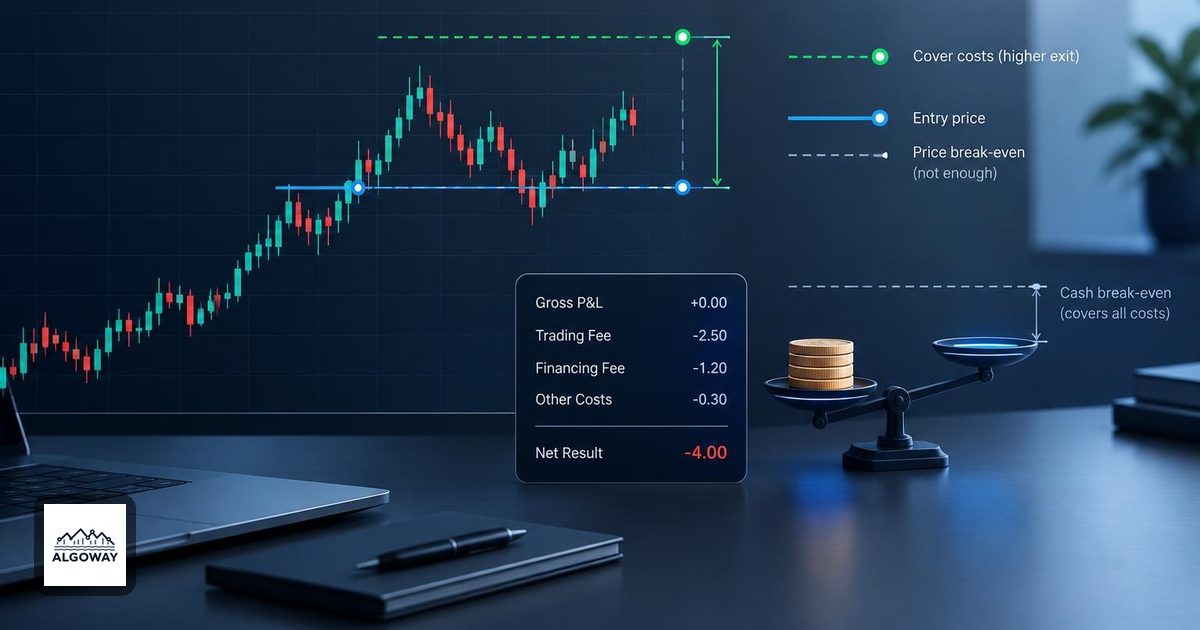
A stop at the entry price can finish with a loss on the account statement. The price has returned to where the trade began, but the broker has not returned the commission.
Price break-even means the entry and exit fills match. Net break-even means the trade's price profit also covers its costs. Neither makes an ordinary stop a guaranteed exit price. That distinction matters when an automated trading rule moves a stop to entry: the rule changes an order level, not the accounting definition of a profitable trade.
For an AlgoWay workflow ending in MT5, use the AlgoWay guide to Bid/Ask and stop-distance checks alongside this calculation. A cost-adjusted level must still be a valid stop at the moment you request it. This article explains the arithmetic; it does not assume that a particular breakeven setting automatically reimburses every fee.
Start with fills, then count separate charges
Suppose you buy 100 units at an actual fill of $50.00 and later sell all 100 at $50.00. Price profit is zero. If opening commission is $1 and closing commission is $1, the net result is minus $2. These are illustrative charges, not a broker tariff.
Use actual execution prices, rather than a chart's midpoint or the price at which an alert fired. For ordinary Bid/Ask execution, buying takes place at Ask and selling at Bid, as explained in MetaTrader 5's trading principles. A long position therefore needs the closing sell quote to reach its actual entry fill to achieve price break-even.
The spread is already reflected in those buy and sell fills. Do not subtract it a second time from fill-based profit. IG's explanation of trading costs distinguishes spread embedded in prices from separately charged commission and holding costs. Its fee schedule is specific to its products; the accounting distinction is the useful part here.
Calculate the exit that covers the costs
For a linear instrument, with profit and charges measured in the same currency, define V as the money gained or lost by the entire position for a one-unit change in price. Let C be the total separate cost of opening, holding and closing that position. Then:
- Long net break-even exit = entry fill + C / V.
- Short net break-even exit = entry fill - C / V.
For 100 shares, a $1 price move changes gross profit by $100, so V is 100. With $2 of total commission and no other costs, the required favorable movement is $2 / 100 = $0.02 per share.
| Illustrative long trade | Gross result | Net after $2 costs |
|---|---|---|
| Buy 100 at $50.00, sell at $50.00 | $0 | -$2 |
| Buy 100 at $50.00, sell at $50.02 | $2 | $0 |
| Buy 100 at $50.00, sell at $50.01 | $1 | -$1 |
For a short with the same size and costs, selling at $50.00 requires a repurchase at $49.98 to net zero. If there is another $1 of holding cost, C becomes $3 and the required offset becomes $0.03. Count an expected closing charge even if the broker has not booked it yet.
This simple formula assumes the position size stays fixed, the value per price unit is constant, and costs can be estimated. Percentage commissions may depend on the exit price, so include that dependence when solving for the exit. Currency conversion, inverse contracts and changing contract values need their own profit calculation. Round the proposed price to the instrument's allowed tick, then calculate the net result again.
A calculated price is not a promised fill
If the example stop is set at $50.02 but fills at $49.98, gross profit is minus $2 and the net loss is $4. The cost calculation was not wrong; the assumed execution price did not occur.
Investor.gov's order guide explains that a triggered stop order becomes a market order. A stop price is not a guaranteed execution price. Adding a small buffer may absorb some adverse execution, but cannot insure a trade against every gap. A stop-limit changes that trade-off by controlling the acceptable price while risking no fill; see our stop-loss versus stop-limit comparison.
There is also a placement constraint. For a conventional long-position stop, the market must first move sufficiently above the proposed level for the broker's distance rules to allow it. A level that covers the commission can still be rejected as too close to the current quote. MT5 documents these stop-distance and freeze restrictions. Confirm the accepted stop on the position, rather than treating a sent modification as a completed change.
Define what the automation is protecting
Before testing a breakeven rule, write down whether it protects one entry, the remaining position, or the whole trade including realized partial exits. Those are different calculations. A profitable partial exit can leave the overall trade at net zero even when the remainder closes below its entry; moving the remainder's stop to entry answers another question.
Keep activation and placement separate. Activation is the favorable move that permits the rule to run. Placement is the stop price it requests. Record both, plus actual fills, total size, booked fees, expected exit costs and the broker's modification response. Compare the closed trade's net result with the intended threshold.
Finally, a breakeven stop changes the strategy's exit behavior. It may reduce a loss on one trade and cut off a later recovery on another. Evaluate that rule across the strategy's trades using expectancy after costs, rather than declaring success whenever the stop line reaches entry.