AlgoWay Blog
Guides, manuals and platform references.
Core
- All articles
- FAQ
- PineConnector alternative
- TradersPost alternative
- Automate TradingView alerts
- Automate Telegram signals
- AlgoWay CopyTrader
- cTrader Copier
- TrendSpider with AlgoWay
- How to Automate a TradingView Indicator with Dynamic SL/TP and 1% Risk on MT5
JSON & Alerts
- JSON schema
- Manual alerts
- TradingView without paid subscription
- AlgoWay Strategy Integration in Pine Script
- Python Trading Bot Webhook Integration
- TRALADAL - TradingView Alert Adapter
- TradingView Order Action Alert
- How to use Clone Mode
MT5 / Expert Advisors
Errors
Integrations
- MetaTrader 5
- Tradovate
- TradeLocker
- cTrader
- Match-Trader
- DXtrade
- Capital.Com
- Binance
- Bybit
- MEXC
- OKX
- Bitget
- Hyperliquid
- BingX
- Alpaca
- Interactive Brokers
- Gate.io
- Coinbase
- TooBit
- WEEX
- KuCoin
- Kraken
- ProjectX
- Rithmic
Other Publications
- MT5 EA Webhook JSON Reference
- OANDA MT5 with AlgoWay
- Buy Webhook via Buy Me a Coffee
- AlgoWay vs PineConnector
- Compare AlgoWay with other trading automation tools
- AlgoWay Red News Filter
- Why Paid Trading Indicators Avoid Verifiable Backtests
- How Trade Automation Tools Mislead You
- utomating a Prop-Firm Eval End to End:
- ATP Premium Indicator Testing Bot
- Why TradingView Backtests Win but Live Trades Lose
- Best Prop Firms for Trading Automation and Telegram Signal Copy in 2026
- Four AIs, One Trader, and the Strange Case of TradingView to Alpaca
- TradingView Automation
AlgoWay Strategy Lab
PPO vs MACD: Why Price Scale Changes the Comparison
Published: 2026-11-11 | Author: AlgoWay
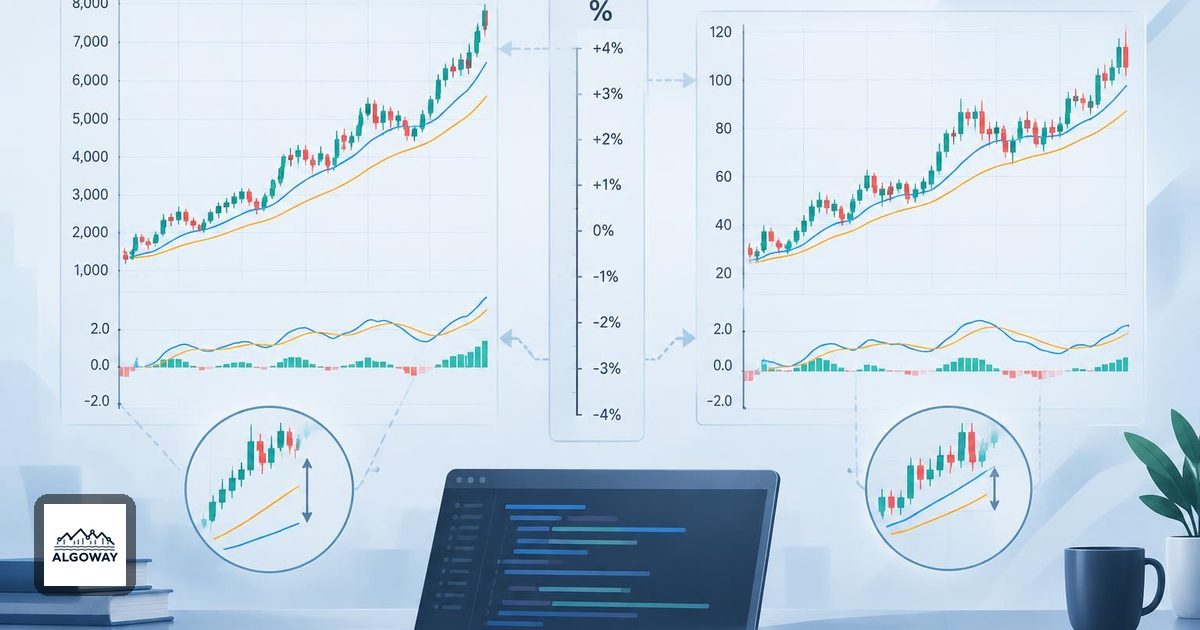
A MACD reading of 20 looks larger than a reading of 2. It may simply belong to an instrument whose price is ten times higher. Before calling one trend stronger, check the ruler.
The Percentage Price Oscillator, or PPO, expresses the gap between two moving averages as a percentage of the slower average. MACD expresses that gap in price units. This distinction matters when one automated rule scans several instruments: a fixed raw MACD threshold can select for price scale as well as momentum.
In an AlgoWay TradingView alert workflow, define the indicator condition before connecting it to execution. Routing an alert does not make a raw-price threshold comparable across symbols.
One gap, two units
TradingView documents PPO as the fast moving average minus the slow moving average, divided by the slow average and multiplied by 100. Its MACD documentation defines the main MACD line as that same difference without the division.
MACD = fast average - slow average
PPO = 100 * (fast average - slow average) / slow average
Consider hypothetical moving-average values, calculated with matching methods and lengths:
- Instrument A: fast average 102, slow average 100. MACD is 2; PPO is 2%.
- Instrument B: fast average 1,020, slow average 1,000. MACD is 20; PPO is 2%.
- Instrument C: fast average 510, slow average 500. MACD is 10; PPO is 2%.
All three have the same proportional separation. A rule requiring MACD above 5 accepts B and C but rejects A. A rule requiring PPO above 1.5% accepts all three. These are arithmetic examples, not a backtest or evidence that either threshold earns money.
What normalization fixes, and what it leaves alone
Suppose every price in A's history is multiplied by ten, with the same moving-average construction and initialization. The averages and their difference scale by ten. In PPO, the numerator and denominator both scale by ten, so their ratio is unchanged. This is why a percentage measure can help compare price histories that live on different numerical scales.
That does not make the instruments equally risky. Equal PPO values say nothing by themselves about contract multipliers, available liquidity, spread, stop distance or account exposure. A 2% moving-average separation is also not a 2% forecast return, a 2% account risk or a probability of winning.
PPO normalizes by the slow price average, not by volatility. A quiet instrument and a volatile instrument can have the same PPO while behaving very differently around an entry. Keep signal comparison separate from stop distance and position sizing.
A zero crossing can match while a signal crossing differs
With identical underlying averages and a positive slow average, MACD and PPO have the same sign. Both main lines reach zero when the fast and slow averages are equal. Replacing a main-line zero-cross rule with PPO therefore does not create a new event under those assumptions.
Do not extend that conclusion to every signal-line crossover. Each oscillator's signal line is a moving average of its own values. Dividing today's MACD by today's slow average is not generally equivalent to dividing an entire smoothed MACD history by that one number: the historical denominators change.
A small illustrative calculation makes the difference visible. Take two consecutive MACD values of 1 and 1.1, with corresponding slow averages of 100 and 120. The PPO values are 1% and about 0.917%. Using a two-value simple average as the signal, the latest MACD sits above its signal of 1.05, while the latest PPO sits below its signal of about 0.958%. This is an illustration of the calculation, not a recommendation for a two-period setting.
The difference between a main-line zero cross and a histogram zero cross still matters. A histogram compares an oscillator with its signal line, not with zero momentum.
Write the comparison rule before wiring the alert
Record the source price, fast and slow lengths, moving-average types, timeframe and whether the decision waits for a completed calculation bar. TradingView exposes separate moving-average choices for the oscillator and signal. Matching only the familiar length numbers does not establish matching calculations.
Then name the event precisely. “PPO above 1.5%” describes a state that can persist for many bars. “PPO crosses above 1.5% on a completed bar” describes a transition. Decide whether another entry is allowed while an existing trade remains open; the indicator's units cannot answer that order-management question.
For a comparison exercise, save the actual fast average, slow average, oscillator value and condition result for the same timestamp on each instrument. Check the calculation before comparing trade results. If the purpose is to compare proportional moving-average gaps, PPO supplies the appropriate units. It does not supply the rest of the trading system.