AlgoWay Blog
Guides, manuals and platform references.
Core
- All articles
- FAQ
- PineConnector alternative
- TradersPost alternative
- Automate TradingView alerts
- Automate Telegram signals
- AlgoWay CopyTrader
- cTrader Copier
- TrendSpider with AlgoWay
- How to Automate a TradingView Indicator with Dynamic SL/TP and 1% Risk on MT5
JSON & Alerts
- JSON schema
- Manual alerts
- TradingView without paid subscription
- AlgoWay Strategy Integration in Pine Script
- Python Trading Bot Webhook Integration
- TRALADAL - TradingView Alert Adapter
- TradingView Order Action Alert
- How to use Clone Mode
MT5 / Expert Advisors
Errors
Integrations
- MetaTrader 5
- Tradovate
- TradeLocker
- cTrader
- Match-Trader
- DXtrade
- Capital.Com
- Binance
- Bybit
- MEXC
- OKX
- Bitget
- Hyperliquid
- BingX
- Alpaca
- Interactive Brokers
- Gate.io
- Coinbase
- TooBit
- WEEX
- KuCoin
- Kraken
- ProjectX
- Rithmic
Other Publications
- MT5 EA Webhook JSON Reference
- OANDA MT5 with AlgoWay
- Buy Webhook via Buy Me a Coffee
- AlgoWay vs PineConnector
- Compare AlgoWay with other trading automation tools
- AlgoWay Red News Filter
- Why Paid Trading Indicators Avoid Verifiable Backtests
- How Trade Automation Tools Mislead You
- utomating a Prop-Firm Eval End to End:
- ATP Premium Indicator Testing Bot
- Why TradingView Backtests Win but Live Trades Lose
- Best Prop Firms for Trading Automation and Telegram Signal Copy in 2026
- Four AIs, One Trader, and the Strange Case of TradingView to Alpaca
- TradingView Automation
AlgoWay Strategy Lab
Pine Strategy Currency: Why Reported Profit Changes
Published November 19, 2026 · View Markdown
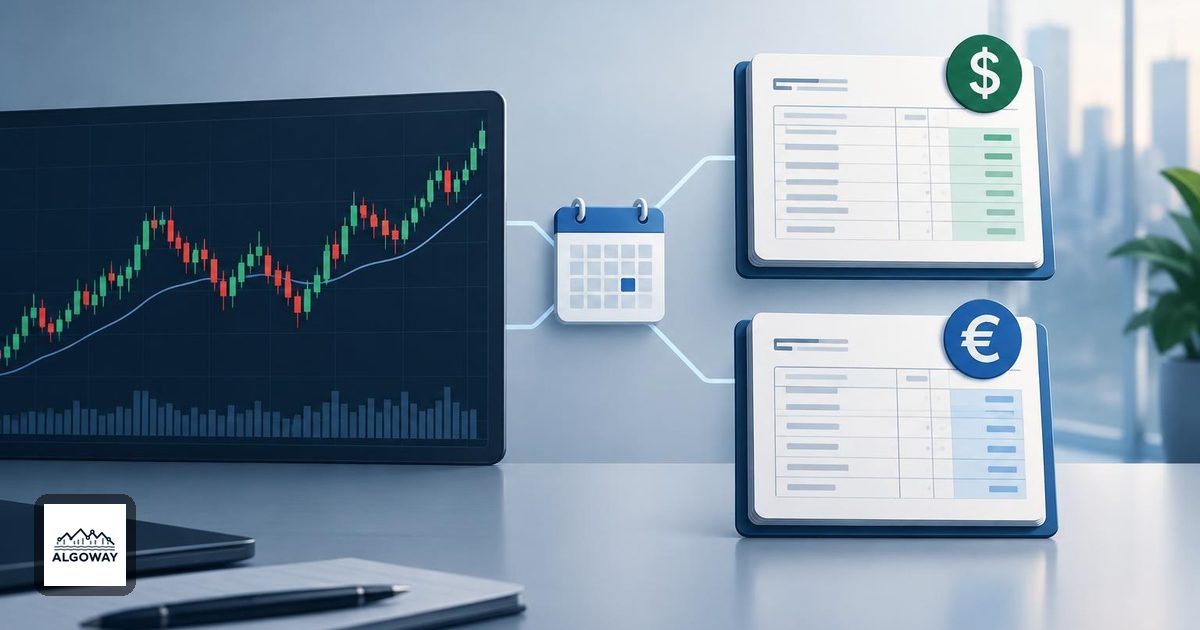
Changing a strategy report from dollars to euros can change the profit number without changing the price move you traded. It can also change the simulated trade size if the strategy sizes orders in cash or as a share of equity. Those are two different effects, and a useful comparison separates them.
Before using TradingView automation with AlgoWay, write down the unit behind each number: chart price, strategy account currency, order quantity and execution-account currency. Use the tick-to-price and cash conversion guide for the first calculation, then check the currency conversion described here. A monetary backtest result is not, by itself, a lot-size instruction.
Identify which currency the report uses
The account-currency selector sits beside initial capital in TradingView's current general strategy settings. Monetary results are shown in that currency. The official general-settings guide also distinguishes fixed quantity, cash amount and percentage-of-equity order sizing. A quantity explicitly supplied by the script overrides the default order-size setting for that order.
In Pine, syminfo.currency identifies the chart symbol's quoted currency and strategy.account_currency identifies the strategy's account currency. With currency.NONE, the default is the chart currency. When conversion is needed, TradingView's Pine currency documentation specifies a previous daily conversion value, with a derived cross rate when a direct pair is unavailable. Do not substitute a live intraday FX quote and expect the same report calculation.
Hold the trade constant before comparing profit
Take a hypothetical instrument quoted in USD. Assume a fixed position of two units, each earning $10 for a one-point move, bought at 100 and sold at 103. Ignore fees for this illustration.
- Price gain: 103 − 100 = 3 points.
- Profit in the symbol's currency: 3 × $10 × 2 = $60.
- At an assumed conversion rate of 0.90 EUR per USD: $60 × 0.90 = €54.
- At an assumed conversion rate of 0.95 EUR per USD: $60 × 0.95 = €57.
Neither euro figure describes a better entry or exit. The assumed price path and quantity are identical; the measuring unit changed. These are hypothetical conversion snapshots, not historical rates or results from a strategy test.
The direction of the rate matters. If the rate is expressed as USD per EUR, divide the USD amount by that rate to obtain EUR. Label the numerator and denominator on your worksheet. An unlabeled exchange rate is a perfectly good number waiting to cause trouble.
Now check whether order size also changed
A cash-based order uses an amount in the strategy account currency, whereas fixed-quantity sizing specifies units such as shares or contracts. Percentage sizing depends on equity. TradingView documents these distinctions in strategy properties. Therefore, changing the currency while leaving a cash input numerically unchanged need not preserve exposure.
For a second arithmetic example, assume a $50 share price and a conversion rate of 1.25 USD per EUR. A cash budget of 1,000 USD buys 20 shares. A cash budget of 1,000 EUR converts to 1,250 USD and buys 25 shares. Both settings display “1,000,” but they describe different budgets. This illustration ignores fees and assumes the share quantities are permitted.
If your aim is to isolate reporting conversion, first compare trades with matching entry price, exit price and quantity. If quantities differ, account for the sizing difference before attributing the entire profit change to FX. Also check whether an equity-dependent condition changed the trade list. A fixed quantity alone does not prove the whole strategy is insensitive to account values.
Convert monetary values without double conversion
Pine provides strategy.convert_to_account() for chart-currency amounts and strategy.convert_to_symbol() for the reverse direction. The currency documentation also describes request.currency_rate(syminfo.currency, strategy.account_currency) for inspecting the rate. Keep each calculation's input unit explicit: an amount already expressed in account currency should not be converted from chart currency a second time.
For example, if the $60 result above has already become €54, treating 54 as dollars and multiplying by 0.90 again produces €48.60. That number looks tidy and is wrong. Keep the original symbol-currency amount alongside the converted amount so the calculation can be traced.
Cash commissions deserve the same attention. Pine's declaration reference defines cash-per-order and cash-per-unit fees in account-currency units. A fee setting of 2 is not necessarily the same economic cost after changing the account currency. For fee frequency and quantity effects, see per-order versus per-contract commission.
Keep a comparison record that can explain the difference
For one matched trade, retain the symbol and quote currency, account currency, entry and exit prices, quantity, symbol-currency profit, conversion rate and converted profit. Record fees separately. Then compare initial capital and the sizing mode across the two runs. This is a proposed audit method; no backtest was performed for this article.
When comparing the simulation with an execution account, add that account's currency and its actual trade record. Investigate quantity, fill price and currency translation as separate differences. Otherwise a currency mismatch can masquerade as slippage, or a changed cash budget can masquerade as a more profitable strategy.