AlgoWay Blog
Guides, manuals and platform references.
Core
- All articles
- FAQ
- PineConnector alternative
- TradersPost alternative
- Automate TradingView alerts
- Automate Telegram signals
- AlgoWay CopyTrader
- cTrader Copier
- TrendSpider with AlgoWay
- How to Automate a TradingView Indicator with Dynamic SL/TP and 1% Risk on MT5
JSON & Alerts
- JSON schema
- Manual alerts
- TradingView without paid subscription
- AlgoWay Strategy Integration in Pine Script
- Python Trading Bot Webhook Integration
- TRALADAL - TradingView Alert Adapter
- TradingView Order Action Alert
- How to use Clone Mode
MT5 / Expert Advisors
Errors
Integrations
- MetaTrader 5
- Tradovate
- TradeLocker
- cTrader
- Match-Trader
- DXtrade
- Capital.Com
- Binance
- Bybit
- MEXC
- OKX
- Bitget
- Hyperliquid
- BingX
- Alpaca
- Interactive Brokers
- Gate.io
- Coinbase
- TooBit
- WEEX
- KuCoin
- Kraken
- ProjectX
- Rithmic
Other Publications
- MT5 EA Webhook JSON Reference
- OANDA MT5 with AlgoWay
- Buy Webhook via Buy Me a Coffee
- AlgoWay vs PineConnector
- Compare AlgoWay with other trading automation tools
- AlgoWay Red News Filter
- Why Paid Trading Indicators Avoid Verifiable Backtests
- How Trade Automation Tools Mislead You
- utomating a Prop-Firm Eval End to End:
- ATP Premium Indicator Testing Bot
- Why TradingView Backtests Win but Live Trades Lose
- Best Prop Firms for Trading Automation and Telegram Signal Copy in 2026
- Four AIs, One Trader, and the Strange Case of TradingView to Alpaca
- TradingView Automation
AlgoWay Strategy Lab
IBKR GTC Orders After Stock Splits: Check Before Retry
Published November 14, 2026 · AlgoWay
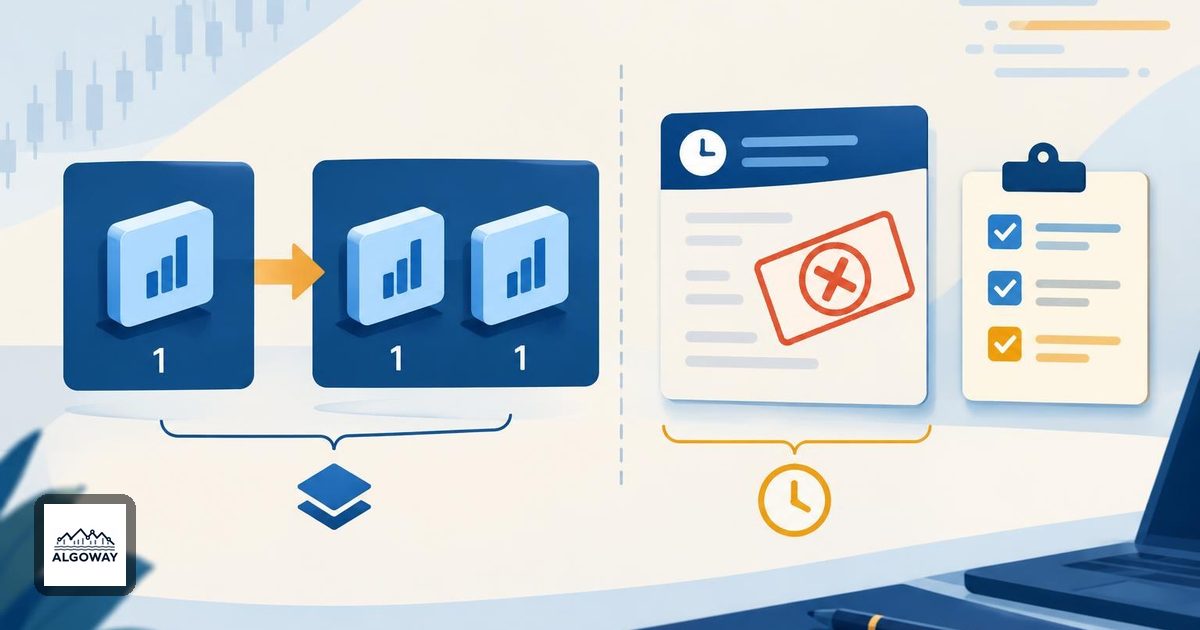
A stock split changes the units in which a position is counted. It does not promise to leave every working order ready for the next session. At Interactive Brokers, stock splits are among the corporate actions that generally cause good-till-canceled orders to be canceled.
For automated trading, the practical question is what remains in the account after the event: the adjusted holding, any fills, and every still-working entry or exit. If you use AlgoWay's TradingView-to-Interactive-Brokers workflow, review those broker records before allowing an old alert or queued retry to submit another instruction. A signal prepared in yesterday's share units can be wrong today even when its JSON is perfectly valid.
What IBKR actually says about GTC cancellation
IBKR's GTC order documentation lists forward and reverse stock splits, exchanges for shares and distributions of shares among its general automatic-cancellation conditions. GTC describes an order's lifetime policy; it is not a guarantee that the order survives corporate actions.
The same documentation qualifies this policy: cancellation is on a best-efforts basis. If corporate-action information arrives late, an order may remain active and eligible for execution. Do not treat a split announcement as a cancellation acknowledgment. Read the actual status of each order.
This distinction cuts both ways. Assuming a canceled protective order still exists can leave a holding without that exit. Assuming an old order has disappeared can produce two orders when a replacement is added. The safe starting point is an account reconciliation, not a replay of the last webhook.
Position adjustment and order replacement are separate
IBKR describes stock splits as mandatory corporate actions that require no client election. That statement concerns participation in the corporate action. It should not be read as confirmation that a particular trading instruction remains working.
Consider a hypothetical two-for-one split. Before the event, you hold 100 shares and have a GTC sell limit for 100 shares at 120. Pure split arithmetic translates those units as follows:
| Item | Before split | Equivalent units after 2-for-1 split |
|---|---|---|
| Holding | 100 shares | 200 shares |
| Reference price | 100 per share | 50 per share |
| Full-position sell instruction | 100 shares at 120 | 200 shares at 60 |
| Instruction's price times quantity | 12,000 | 12,000 |
The last two rows are a mathematical translation, not a statement that IBKR creates a replacement order. The account might show 200 shares and no working sell limit. It might instead still show an old order that needs attention. Market movement can also put the actual quote somewhere other than the simple reference price of 50.
Resubmitting “sell 100 at 120” would retain the old quantity and price scale. It would cover only half of the illustrated post-split holding, at twice the economically equivalent limit. That is not a harmless retry. Before deciding whether to place any new order, confirm that the original trading intention is still appropriate and that the broker's current records agree with the event terms.
Reconcile four records before resuming automation
- The corporate-action notice. Check the effective date, ratio and affected security. Use the broker or issuer notice for the actual event rather than guessing the ratio from a chart gap.
- The position and executions. Read the current holding and recent fills. If an exit filled partly before the split, applying the ratio to the old full holding would overstate the shares still available to sell.
- Every working order. Check entry orders, stops and targets individually. Record status, remaining quantity and price. Resolve active orders before adding overlapping replacements; a cancel request alone is not proof that an order can no longer fill.
- The signal and retry state. Inspect stored quantities, fixed prices and delayed instructions. Prevent a pre-split message from being treated as a fresh post-split decision. Once reconciled, verify any newly submitted order in the broker's records.
This is a suggested operational review, not a claim that AlgoWay automatically adjusts split-related alerts, rebuilds canceled orders or exposes every IBKR time-in-force choice. Use the integration's documented controls. If the intended behavior is unclear, settle it before sending an instruction.
A cancellation label does not explain the whole account
IBKR also documents a CORPACT message for corporate-action-related GTC cancellations. Match such a message to the affected security and order. It is context for investigation, not evidence that the account is flat or that all other orders were canceled too.
For the broader distinction between remaining quantity, canceled orders and actual holdings, see IOC, FOK and GTC order behavior. Around a split, add one more column to that reconciliation: which share and price units each record uses.
The review is finished when the current holding, live orders and next permitted signal describe the same intended exposure in the same units. A reassuring status label is a poor substitute for that agreement.