[Canonical HTML article](https://algoway.trade/blog/spread-versus-commission-round-trip.html)
Published: 2026-11-23
# **Spread vs Commission: Calculate Round-Trip Trade Costs**
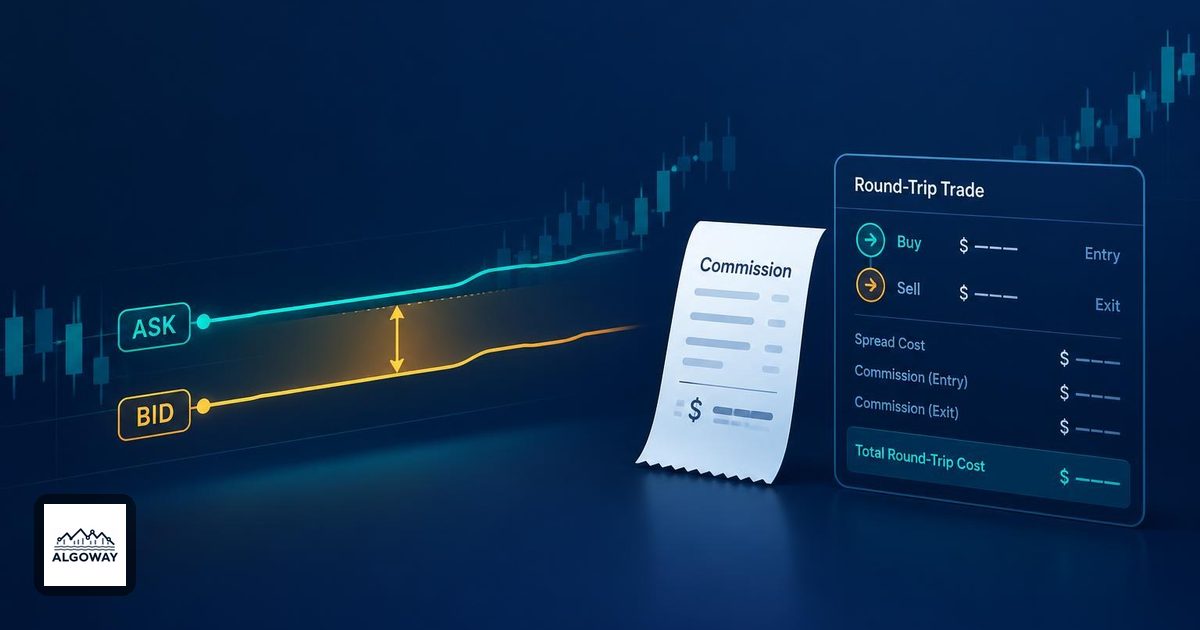
A zero-commission trade can still cost money before the market moves. Buy at the ask and sell at the bid, and the gap between those prices has already done its work. Conversely, a smaller spread with a separate commission is not automatically cheaper. Both charges need the same units and the same round-trip definition.
For automated trading, this is an accounting problem before it is a broker-selection problem. When reviewing trades sent through AlgoWay, follow the [backtest-versus-live comparison workflow](https://algoway.trade/blog/how-to-fix-tradingview-backtest-vs-live-trading-results.html) and use the execution account's fills and fees. The strategy's chart price is not a receipt.
## Spread lives in the prices; commission is a charge
[Investor.gov defines the bid-ask spread](https://www.investor.gov/introduction-investing/investing-basics/glossary/ask-price) as the difference between the bid and ask. For the examples below, assume a marketable buy fills at the quoted ask and a marketable sell fills at the quoted bid, with enough available size. Actual execution can differ: [the SEC's order-execution explanation](https://www.investor.gov/introduction-investing/investing-basics/how-stock-markets-work/executing-order) notes that prices can change before an order reaches the market.
Commission is a separate fee calculation. It may depend on quantity, value, minimum charges or the account's schedule. Read whether the quoted amount is per side or for a complete round trip. As one documented example of the structure, [OANDA Corporation's core-pricing explanation](https://help.oanda.com/us/en/faqs/spreads-commission.htm) combines a spread with commission on opening and closing transactions. That describes a particular division's model, not a universal rate or an account recommendation.
## A round trip with no market movement
Suppose a hypothetical EUR/USD quote is Bid 1.1000 and Ask 1.1002. Trade 10,000 EUR and keep the account calculation in USD. A pip is 0.0001 here, so each pip is worth `10,000 × 0.0001 = $1`. Assume commission of $0.50 on each side. These are invented inputs for arithmetic, not a broker offer.
| Step | Calculation | USD result |
| --- | --- | --- |
| Buy 10,000 EUR at Ask | Entry price 1.1002 | Commission -$0.50 |
| Sell at unchanged Bid | Exit price 1.1000 | Commission -$0.50 |
| Profit from actual fill prices | (1.1000 - 1.1002) × 10,000 | -$2.00 |
| Net result after commission | -$2.00 - $0.50 - $0.50 | -$3.00 |
The two-pip spread costs $2 for this unchanged-quote round trip, not $4. Relative to the midpoint of 1.1001, the buy gives up one pip and the sell gives up one pip. Charging a full spread on both legs would count the same gap twice.
## What changes when the exit spread is wider?
For equal opening and closing quantities, a simple midpoint-based model uses:
`Spread friction = (entry spread / 2 + exit spread / 2) × cash value per price unit`
This follows directly from ask being half a spread above its own midpoint and bid being half a spread below its own midpoint. It measures the difference from a hypothetical midpoint-to-midpoint trade. It is not a promise that either midpoint was executable.
For example, retain the two-pip entry spread but make the exit spread four pips. At $1 per pip, modeled spread friction is `(2 / 2 + 4 / 2) × $1 = $3`. Add the hypothetical $1 round-trip commission and total friction is $4. Any midpoint movement remains the underlying trading gain or loss; it is not itself spread cost.
Partial exits need quantity-weighted calculations for each fill. Different account currencies, contract multipliers and fee minimums require their own conversions. Do not transplant the EUR/USD dollar-per-pip figure into another instrument.
## Compare schedules, then check what the report includes
Using the same $1-per-pip exposure and equal entry/exit spreads, hypothetical schedule A charges a two-pip spread with no commission: $2 per round trip. Schedule B charges a 0.6-pip spread plus $0.80 per side: $2.20. The smaller advertised spread loses this particular comparison. Change the actual spread or fee inputs and the result can change.
For completed trades, fill-price profit already includes the effect of buying and selling at those prices. Subtract explicit commission only if the report has not already deducted it. Do not subtract an estimated spread again. For a backtest using midpoint prices, however, spread is still a missing assumption unless the simulator models it elsewhere.
Keep slippage definitions consistent too. A measurement from signal midpoint to fill price can already contain spread crossing. Adding that entire measurement to a separate spread estimate can double-count part of the execution shortfall.
* Write down whether the starting result uses chart prices, midpoint prices or actual fills.
* Convert spread and all opening/closing commissions into one account currency.
* Separate financing, exchange charges and platform subscriptions where applicable. Spread plus commission is not necessarily the complete cost of holding or operating the strategy.
* When configuring a simulator, distinguish [per-order, per-contract and percentage commission](https://algoway.trade/blog/tradingview-commission-per-order-per-contract.html) before entering a number.
Once the ledger reconciles for one trade, repeat the calculation across the strategy's actual trade sizes and sessions. The useful comparison is the cost of the workflow you run, not the smallest number on a pricing banner.